
Context
A freelancer gets paid at different times, by different payers and often in different currencies: clients, Upwork and Fiverr, Stripe and PayPal payouts, subscribers. The balance in the bank says little about what can be spent this week.
Freeboard began as Bilancio, the dashboard we run our own money with every day. In the autumn of 2026 it became a product, first called Flusso and then Freeboard, in English and Italian.
The problem
Budgeting apps look back at categories of past spending. The question here looks forward: if I pay for this today, do I still stay above zero when the late invoices and the yearly bills arrive? The answer had to be one number, honest about money that might not come.
Constraints
Income that might not come
Every expected payment is certain, half-certain or uncertain, and the forecast counts it in full, at half or not at all.
No bank connections at the start
Open banking access is still restricted in early access, so balances are typed in and bank exports are imported as files.
One person per dashboard
The app was built for one person, so every user gets a dashboard of their own on our server instead of a shared account system.
Colour is never the only signal
Expenses are never red, every state has a word or a shape as well, and touch targets are at least 44 points.
Our role
Product definition, interaction and visual design, the web app, the browser extension, the connector for AI assistants, the product site and demo, the hosting, and now the mobile app.
What we built
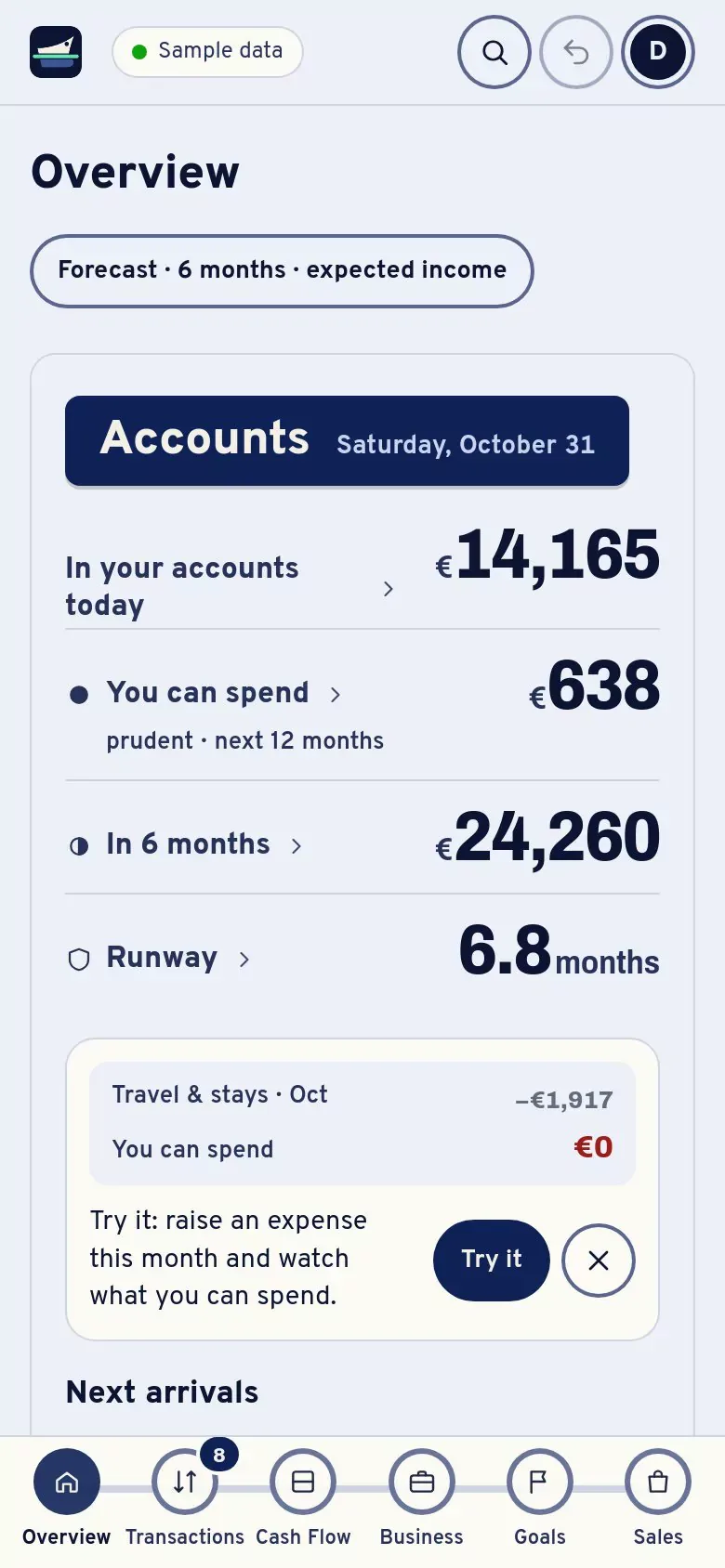
One number: what you can spend
Freeboard projects your cash for the next twelve months and takes the lowest point: certain income counts in full, half-certain at half, uncertain not at all. From there it sets aside goals you reserved, a tax reserve and an emergency fund. What is left is what you can spend today.
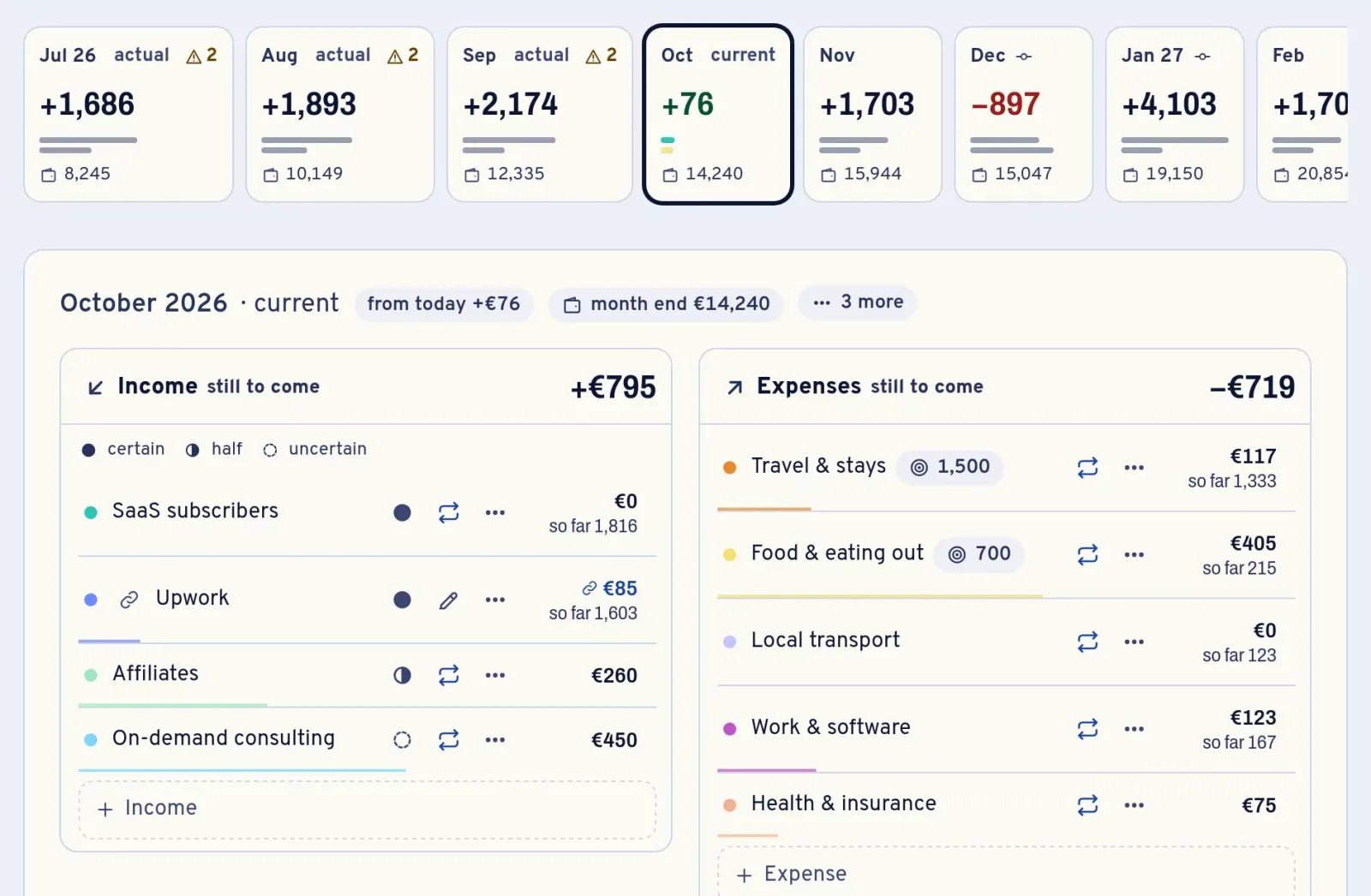
The current month counts what is still to come
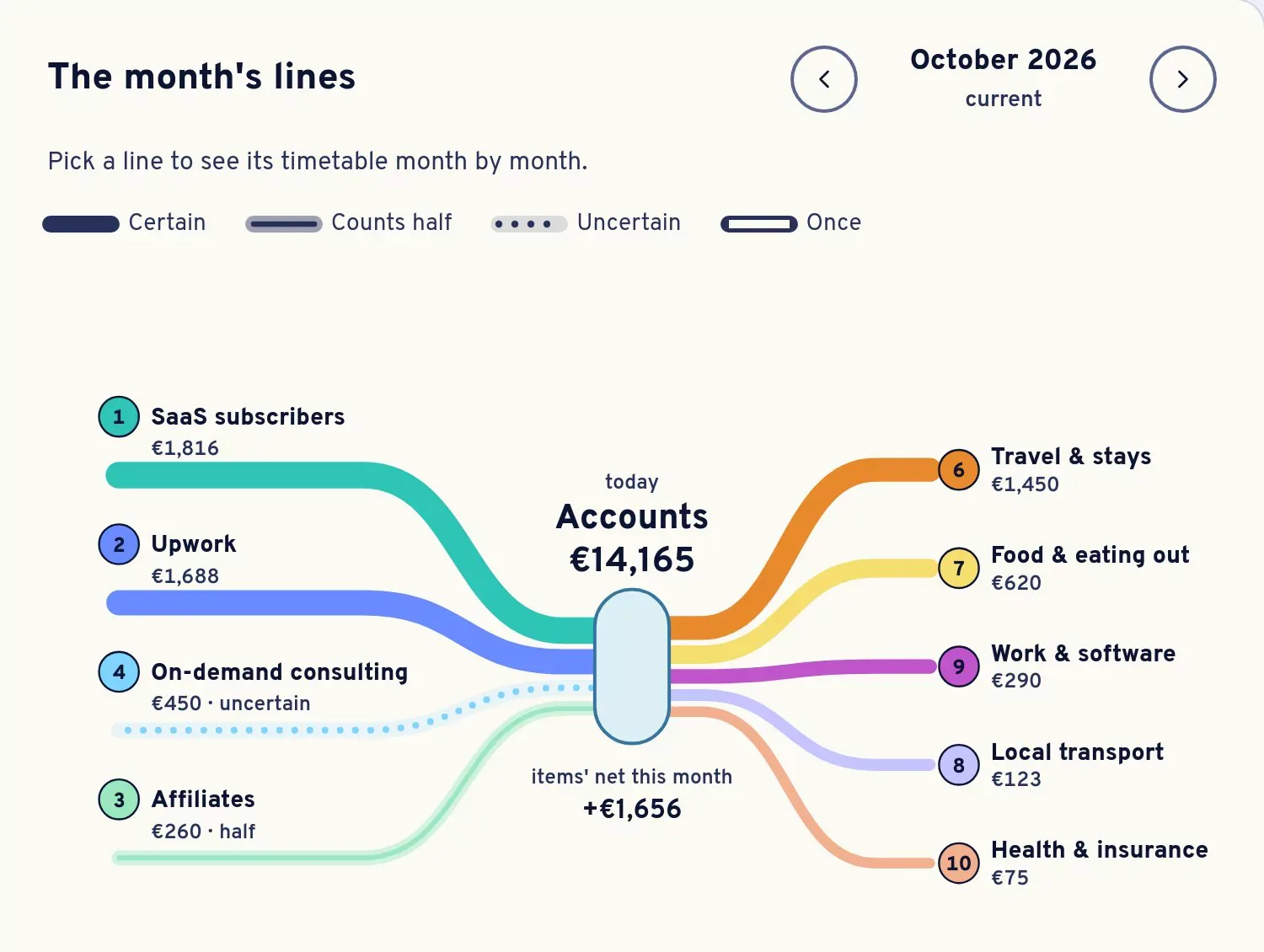
For this month every line holds only what is still to arrive or to be paid before the month ends, since today's balances already contain the rest. Month-end cash is today's cash plus what is still to come, and the following months start from there.
Pockets and goals
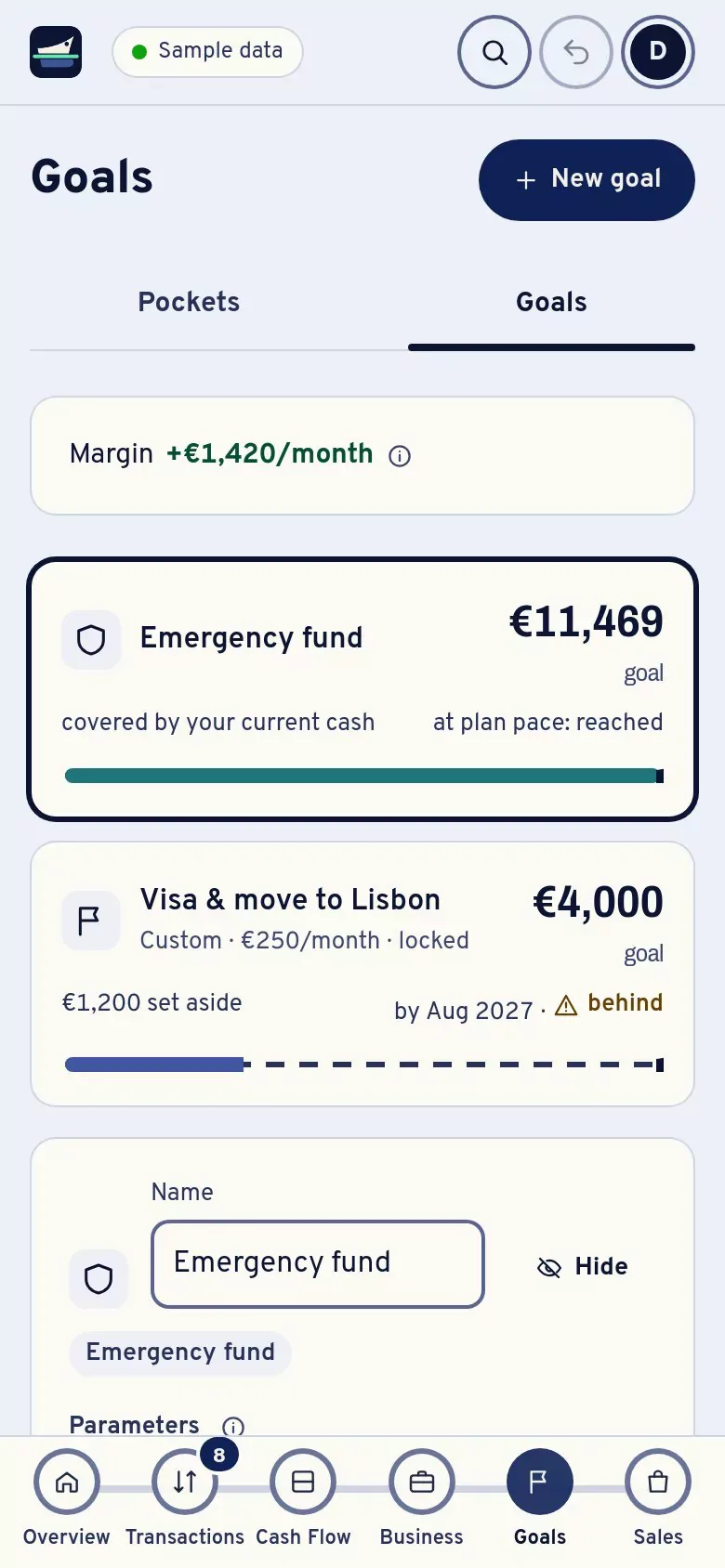
A pocket is money set aside that stays in your accounts: free cash is cash minus pockets, and the expenses a pocket pays come out of it. A goal is either reserved, so it leaves what you can spend, or paid in every month from the Cash Flow.
Bank exports instead of bank logins
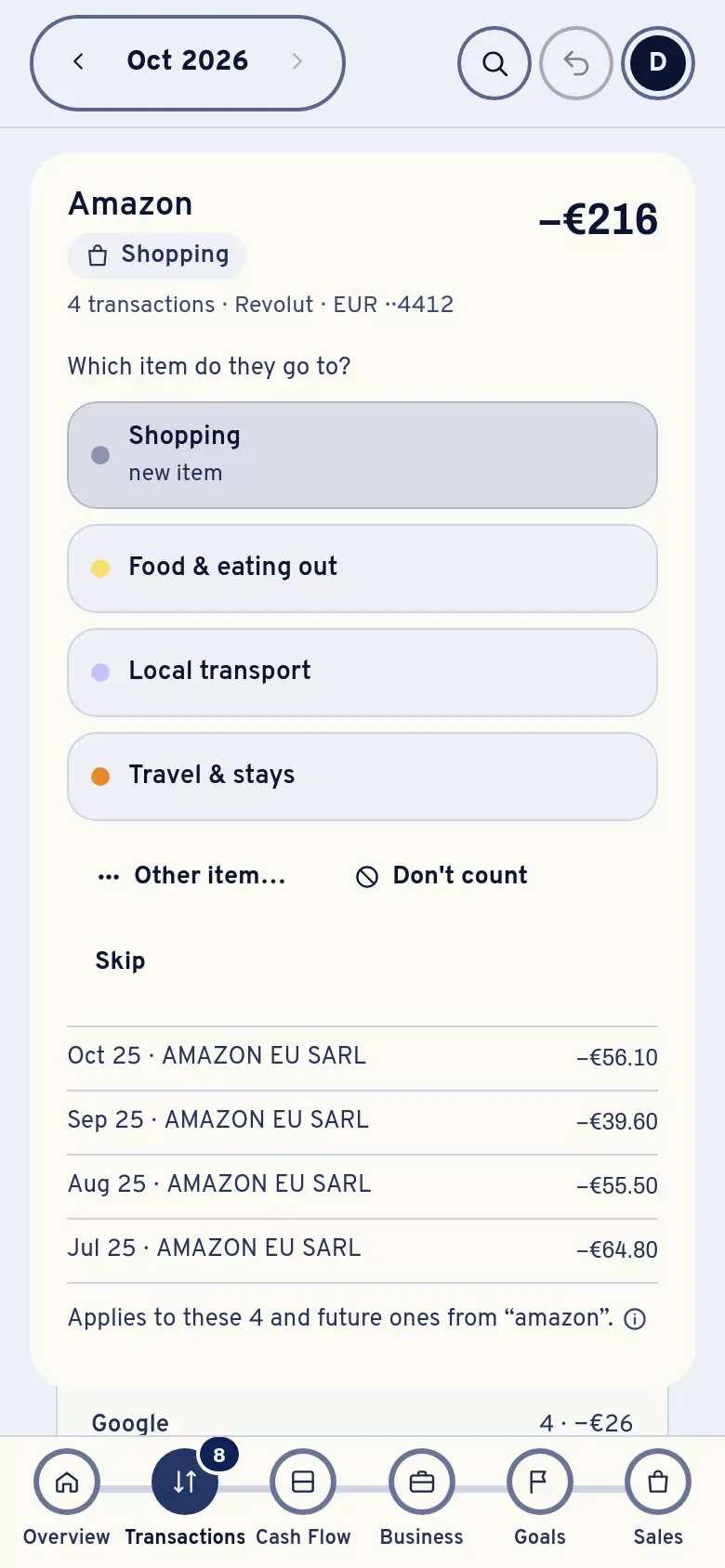
Freeboard reads CSV, Excel, OFX and QFX, QIF and CAMT.053 files in the browser. About 17 banks are recognised by their export, from Revolut, Wise and N26 to Chase, and importing the same file twice creates no duplicates.
Many currencies
You choose a main currency among euro, dollar, pound, Swiss franc and Canadian and Australian dollar. Spending is broken down by currency, and card payments get a category from the merchant code.
An extension for the moment you are about to pay
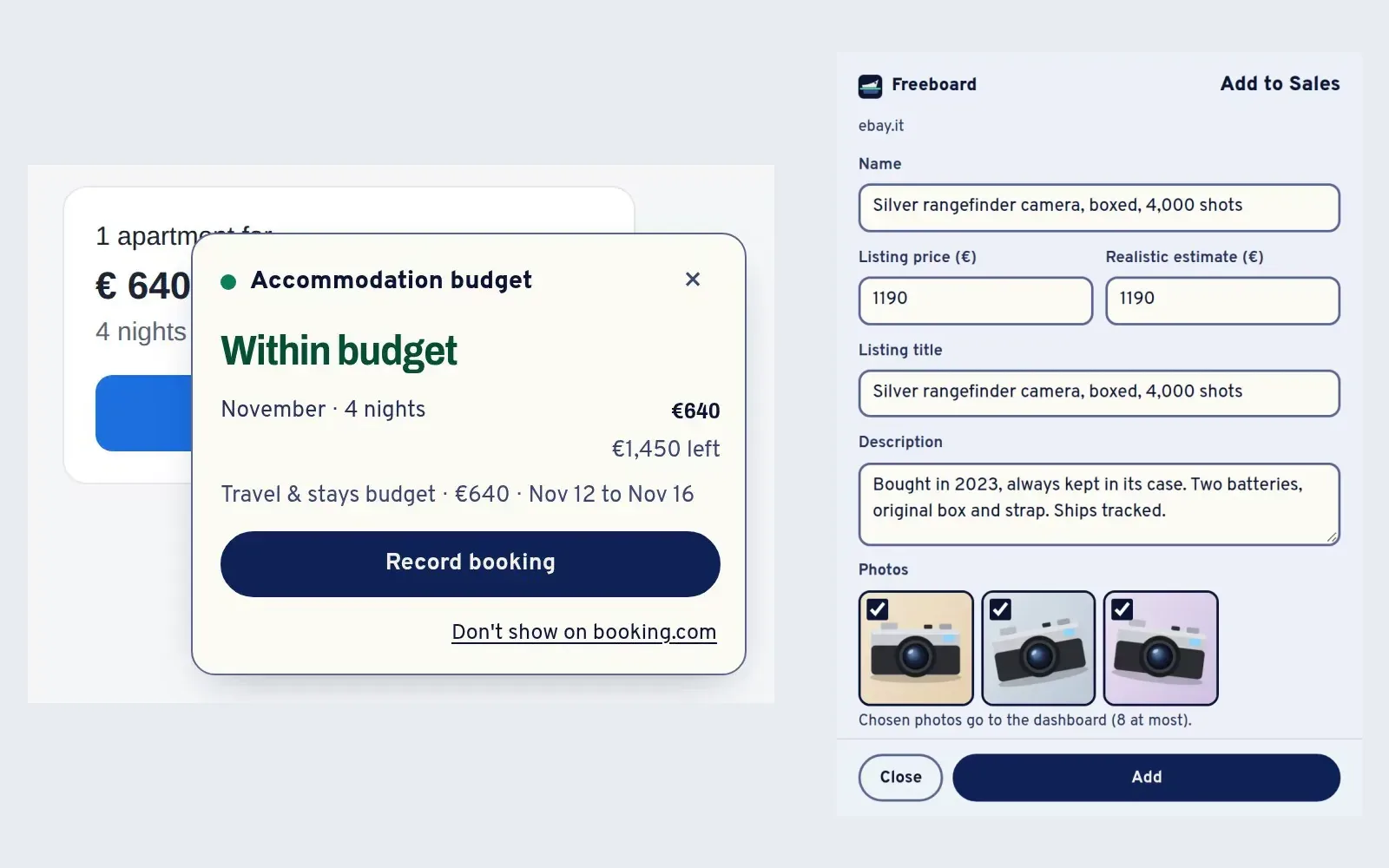
The browser extension for Chrome, Edge and Brave checks a booking or a purchase against your budget on the page where you make it, and adds an item you want to sell to your sales from the listing page. A Safari build exists too.
A connector for Claude and ChatGPT
An MCP server with OAuth 2.1, PKCE and dynamic client registration lets an AI assistant read and update the dashboard through 19 tools, at one address for every dashboard. Every change can be undone, and the text of bank transactions is treated as data, never as instructions.
A demo you can break
The public demo runs on sample data that resets every day, and each visitor's changes stay in their own browser tab.
Two languages from one codebase
The code is written in Italian; the English app is generated from 4,858 translated strings, so both languages ship together.
What shipped
- 31 Aug 2026
- First commit: the dashboard we already used every day, imported
- 29 Sep 2026
- Connector for AI assistants; English by default
- 3 Oct 2026
- Browser extension, first release the next day
- 4 Oct 2026
- Product site and public demo
- 10 Oct 2026
- Flusso becomes Freeboard; choice of main currency
- 18 Oct 2026
- Early access with one hosted dashboard per person
- 21 Oct 2026
- Extension on the Chrome Web Store
- 7 Nov 2026
- Import of bank export files
- 9 Nov 2026
- One connector address for the Claude and ChatGPT directories
- 16 Nov 2026
- Android app on Google Play; plugin published in ChatGPT
- Tests
- 10 test scripts and 8 files of expected numbers for four sample datasets, run before every deploy; the mobile app runs 44 unit tests and 9 end-to-end specs in continuous integration
- Not yet
- The iPhone app and the Safari extension are waiting for App Store approval; the listing in the Claude directory is in review
See it livefreeboard.moneyThe live demoOn Google PlayOn the Chrome Web StoreIn ChatGPT